LLM agentic workflow
A multi-agent task pipeline that models an LLM-serving system — and never makes a real LLM or network call. It walks the sequential core (5.3) and both parallelism showcases (5.4), and links back to Which parallelism do I need?.
The code lives in examples/agentic_workflow/.
The core model
Tasks arrive at an orchestrator (Poisson). Each becomes an agent process that alternates:
- think steps — inference requests queued at shared, batching LLM-server
Resources with token-length-dependent service times. Under load the queue backs up and batches grow; under light load a batch is one request — both deterministically. - act steps — tool calls with stochastic latency, failures, and bounded retries. A call that fails every attempt surfaces the failure, aborting the task.
Bounded agent concurrency is a finite-capacity Resource. KPIs are end-to-end
task latency, inference-queue depth, and cost per task.
from examples.agentic_workflow import AgenticConfig, run_sequential

kpis = run_sequential(seed=20260712, config=AgenticConfig())
print(kpis.mean_latency, kpis.mean_queue_depth, kpis.mean_cost)
No network, ever
The example simulates an LLM server: every service time is drawn from
sim.rng. A test disables all socket entry points, bans network/LLM imports
from the package by AST scan, and asserts the model still runs with no
llmsim[llm] extra installed — the no-network rule is enforced, not assumed.
Showcase 5.4a — capacity-planning sweep
study_capacity.py builds an Experiment over a (server count × batch size ×
agent concurrency) grid, runs independent replications, and reports a 95%
confidence interval per KPI. Same Phase 2 guarantee: bit-identical on any
backend or worker count for a fixed master seed.
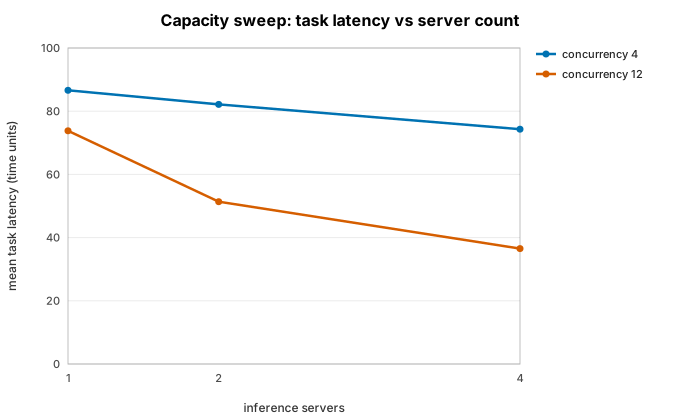
Latency falls as servers and agent concurrency rise — the trade-off surface a
capacity planner reads. Regenerate with
python -m examples.agentic_workflow.study_capacity.
Slowdown regime
Replication throughput follows the measured replication-scaling curves; absolute speedup on anti-scaling interpreters is recorded-not-blocking.
Showcase 5.4b — strict-mode offload
offload.py moves the per-think-step routing score — a deliberately
CPU-heavy pure function — onto the offload worker pool via
sim.offload(..., strict=True). In strict mode the result is delivered at a
deterministic completion slot regardless of which backend computes it, so the
run is bitwise-identical whether the pool is inline or a real worker pool.
Wall-clock worker latency never leaks into the simulated trace.
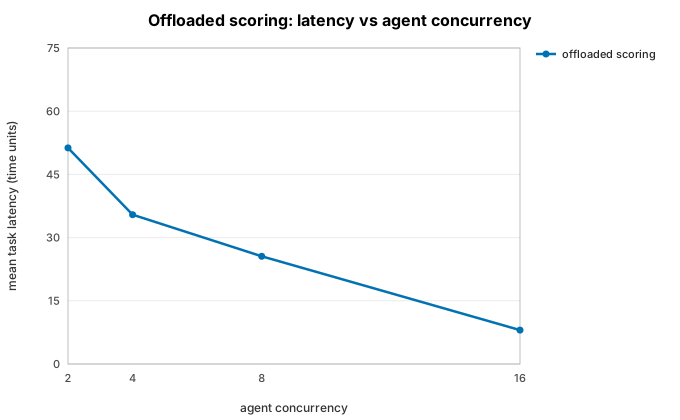
The curve is the offloaded model's latency as concurrency rises; every point is
identical across the inline, threads, and processes backends — that
equivalence is the whole point. Regenerate the trace-equivalence check with
pytest tests/test_agentic_offload.py.
Slowdown regime
Offload wall-clock speedup is bounded by the max-vs-sum ceiling: the sim thread waits for the slowest concurrent offload, not the sum, so speedup saturates once the pool covers the concurrent batch (see performance notes). The determinism guarantee holds at any speedup.