Ride-hailing fleet
An autonomous robotaxi fleet serving Poisson trip requests over a discrete zone graph, built entirely on the public llmsim API. It walks the sequential core (5.1) and both parallelism showcases (5.2), and links back to Which parallelism do I need?.
The code lives in examples/ride_hailing/.
The core model
Zones are nodes on a ring with fixed inter-zone travel times and a strictly positive minimum. That minimum matters twice: it is the shortest deadhead a dispatch policy can see, and it is exactly the channel lookahead the sharded variant needs. Continuous coordinates would give adjacent points a ~0 lookahead and no feasible sharding — so the geometry is discrete by design.
Each vehicle is a generator process running the full lifecycle — idle → drive to
pickup → carry the trip → drop off → reposition → recharge — with a
state-of-charge depleted by travel. Charging stations are finite-capacity
Resources; idle vehicles wait in a FilterStore; requests abandon if
unassigned within a patience window.
from examples.ride_hailing import RideHailingConfig, run_sequential

kpis = run_sequential(seed=20260712, config=RideHailingConfig())
print(kpis.mean_wait, kpis.mean_utilization, kpis.abandonment_rate)
Dispatch policies
A request pulls out the vehicle its dispatch policy ranks best across all
zones — never restricted to the origin zone — with ties broken by ascending
vehicle id, so the choice never depends on FilterStore order:
closest_available— the nearest idle vehicle by inter-zone travel time.power_of_d— sampledidle candidates viasim.rng, then pick the nearest.
Both sit behind one protocol and are selected through the config, so policy choice flows through the seed tree deterministically.
Showcase 5.2a — fleet-sizing Monte Carlo
study_fleet_sizing.py builds an Experiment over a (fleet size × demand) grid,
runs independent replications, and reports a 95% confidence interval per KPI.
This is the Phase 2 showcase: many independent Sims, one per worker,
bit-identical on any backend or worker count for a fixed master seed.
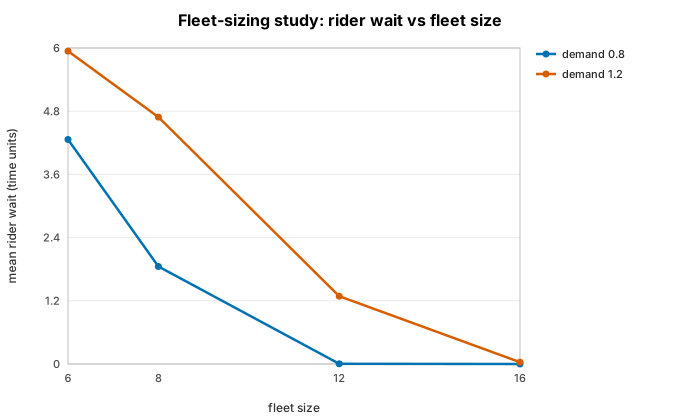
Rider wait collapses as the fleet grows past the demand it serves — the curve a
capacity planner reads to size a fleet. Every point is a deterministic study
output; regenerate with python -m examples.ride_hailing.study_fleet_sizing.
Slowdown regime
Replication throughput follows the measured replication-scaling curves: near-linear on the process backend, flat-to-anti-scaling on free-threaded threads under refcount contention. Absolute speedup on anti-scaling interpreters is recorded-not-blocking; the results are identical regardless.
Showcase 5.2b — zone-sharded PDES
sharded.py partitions the fleet into zone-group shards, one Sim each, run
thread-per-shard. Each shard serves its own requests from its own fleet; a trip
whose destination lies in another zone group becomes a vehicle migration — a
channel message carrying plain (vehicle_id, soc, zone) data with
delay = trip_time, which is always at least the minimum inter-zone time. That
minimum is the channel lookahead.
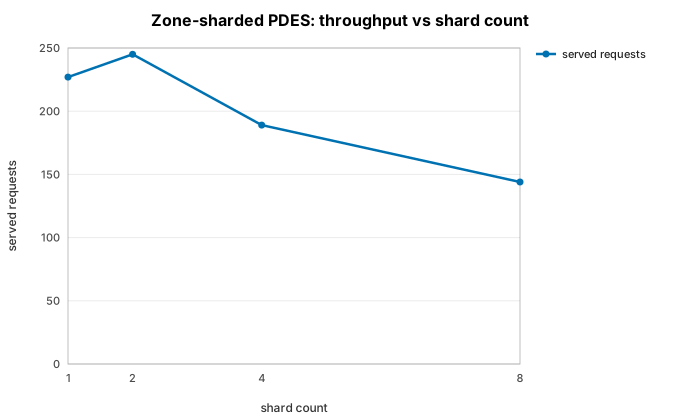
The curve holds the total demand fixed (each shard serves its zone-group's
share, request_rate / shards) and varies only the partition. Throughput peaks
around two shards and then falls: partitioning the same workload fragments the
fleet, so each shard has fewer local vehicles to serve its own requests. That is
the honest PDES trade-off — the point is not a free speedup but that the
determinism guarantee holds at every shard count.
Global cross-zone dispatch (ranking vehicles a shard does not own) is not
share-nothing-decomposable, so the sharded variant uses local dispatch plus
migration — an honest PDES decomposition, not a bitwise clone of the monolithic
model. The guarantee it proves is the Phase 3 one: the threaded run is
bitwise-identical to the sequential reference (mode="sequential") of the same
topology, at 1/2/4 shards.
Slowdown regime
Shard scaling degrades as the channel lookahead shrinks toward the local event spacing (see PDES scaling, lookahead → 0). The ring metric keeps the minimum inter-zone time strictly positive, which is what makes sharding feasible here at all.